Isolinear Chips: Difference between revisions
m 2 revisions imported |
|||
| (3 intermediate revisions by the same user not shown) | |||
| Line 1: | Line 1: | ||
{{Incomplete page}}{{ | {{Incomplete page}}{{Infobox_Old|first_appearance=[[Star Trek: The Next Generation]]|designer=Unknown|builder=Unknown|latest_appearance=Unknown|affiliation=[[Starfleet]]|function=Data Storage and Processing|dimensions=86mm x 25mm x 2.6mm|image=[[File:ISOChips.jpg|250px]]|image-caption=Screen-Used Isolinear Chips|image2=[[File:IsolinearChipsInPADD.jpeg|250px]]|image2-caption=An Isolinear Chip in [[Star Trek: The Next Generation]]}} | ||
'''Isolinear Chips''', otherwise known as '''Isolinear Optical/Processing Chips''', are a technology introduced in [[Star Trek: | '''Isolinear Chips''', otherwise known as '''Isolinear Optical/Processing Chips''', are a technology introduced in [[Star Trek: The Next Generation]]. Isolinear systems are what generally run a starship in that era, replacing the duotronic systems in [[Star Trek: The Original Series|The Original Series]]. Isolinear chips are a physical storage medium as well as an operational and processing controller. | ||
== Design and History == | == Design and History == | ||
Isolinear chips feature a circuit-like design on either one or both sides of the ship. Generally, hero chips always have the design on both sides. This design is | Isolinear chips feature a circuit-like design on either one or both sides of the ship. Generally, hero chips always have the design on both sides. This design is generally silkscreened. | ||
'''TODO:''' The design on the isolinear chips changed over time during the run of TNG/DS9/VOY. All variations on the art should be catalogued and organized. | '''TODO:''' The design on the isolinear chips changed over time during the run of TNG/DS9/VOY. All variations on the art should be catalogued and organized. | ||
'''TODO:''' Discuss the Enterprise-E isolinear chips, and the Enterprise-B isolinear chips from Star Trek: Generations. | '''TODO:''' Discuss the Enterprise-E isolinear chips, and the Enterprise-B isolinear chips from Star Trek: Generations. | ||
== Early Variant == | |||
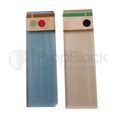
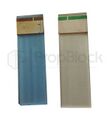
Isolinear chips briefly feature in Seasons 1 and 2 of The Next Generation, with a slightly different look. They are similarly-shaped acrylic rectangles, featuring no circuit printing, and the labels are just simple colors and shapes in a similar vein to the later styles. They usually feature a Red or Black dot on the label, sometimes both, in random assortments. These were phased out some point in the early run of TNG. | |||
The labels themselves seem to be Avery Self-Adhesive File Folder labels, measuring either 9/16" x 3 7/16", or possibly, 11/16" x 3 7/16" and wrapped around the acrylic. The dots also appear to be an Avery product, Avery Color-Coding Removable Labels, 1/4" Diameter. Further research and samples are needed to determine what size they are. | |||
==Media== | ==Media== | ||
Latest revision as of 01:17, 5 January 2026
Incomplete Page! This page is incomplete! The author might still be writing it, or there are TODO markers around, indicating some work to be done.
| Isolinear Chips | |

| |
| Screen-Used Isolinear Chips | |

| |
| An Isolinear Chip in Star Trek: The Next Generation | |
| First appearance | Star Trek: The Next Generation |
| Latest appearance | Unknown |
| Designed By | Unknown |
| Built by | Unknown |
| Dimensions | 86mm x 25mm x 2.6mm |
| In-universe information | |
| Affiliation | Starfleet |
| Primary Function | Data Storage and Processing |
Isolinear Chips, otherwise known as Isolinear Optical/Processing Chips, are a technology introduced in Star Trek: The Next Generation. Isolinear systems are what generally run a starship in that era, replacing the duotronic systems in The Original Series. Isolinear chips are a physical storage medium as well as an operational and processing controller.
Design and History
Isolinear chips feature a circuit-like design on either one or both sides of the ship. Generally, hero chips always have the design on both sides. This design is generally silkscreened.
TODO: The design on the isolinear chips changed over time during the run of TNG/DS9/VOY. All variations on the art should be catalogued and organized.
TODO: Discuss the Enterprise-E isolinear chips, and the Enterprise-B isolinear chips from Star Trek: Generations.
Early Variant
Isolinear chips briefly feature in Seasons 1 and 2 of The Next Generation, with a slightly different look. They are similarly-shaped acrylic rectangles, featuring no circuit printing, and the labels are just simple colors and shapes in a similar vein to the later styles. They usually feature a Red or Black dot on the label, sometimes both, in random assortments. These were phased out some point in the early run of TNG.
The labels themselves seem to be Avery Self-Adhesive File Folder labels, measuring either 9/16" x 3 7/16", or possibly, 11/16" x 3 7/16" and wrapped around the acrylic. The dots also appear to be an Avery product, Avery Color-Coding Removable Labels, 1/4" Diameter. Further research and samples are needed to determine what size they are.
Media
-
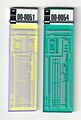 Isolinear Chips scanned on a flatbed scanner. Due to the light of the scanner, the neon-green (left) appears yellow, and the aqua (right) appears brighter.
 -
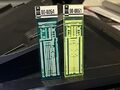 Same chips, correct colors.
 -
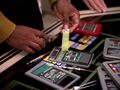 Isolinear Chips from the inside of a PADD. Guest starring some 20th century circuit boards.
 -
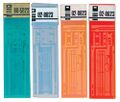 Screen-Used ISO Chips, various.
 -
 Early iteration of the ISO Chip from Seasons 1 and 2 of TNG.
 -
 Screen-used Early ISO Chip.
 -
 Ditto, rear.
 -
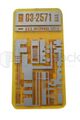 Screen-Used Enterprise-E ISO Chip.
 -
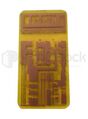 Ditto, rear.
 -
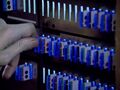
 A not-oft-seen Isolinear Chip in VOY, due to that ship's reliance on Bio-Neural Gel Packs.
 -
 The isolinear chip's label design cameo's on an away team's kit in VOY.


Trivia
- In the VOY episode "Memorial" (S6xE14) the away team returns from a mission with athletic bags that feature a label design that is taken straight from the later TNG Isolinear Chips. (see Media)